This description of soil is by Dr Tony Kendle, soil scientist, ex of Eden Project and Reading University
Soil is the upper layer of the solid Earth and, like biodiversity, it is the product of millions of years of evolution. Like much of our world, it is co-created by the life that it supports.
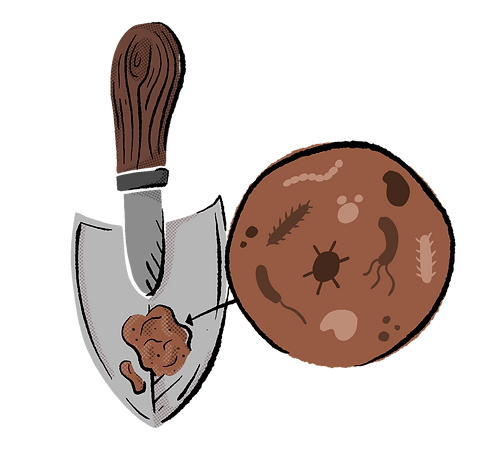
A teaspoon of healthy soil contains between 100 million and 1 billion bacteria and hundreds and thousands of fungi.
This amounts to as much mass as two cows per acre of land, so a ton of microscopic bacteria may be active in each acre of soil. `These bacteria, and the fungi which live alongside them, are accomplished alchemists. They digest the remains of previous lives so that without their work we would be buried in the remains of the dead. All resources would be frozen and all life impossible.
Over evolutionary time these bacteria have evolved key processes such as photosynthesis and respiration. These are the two counter balances of the energy cycle which make all life possible and restore oxygen to the air. Soils are not just for growing, they are where essential things happen.
Like many small, precious and complex things the detailed micro structure of soils is easily destroyed. Too much pressure, especially when wet, can easily turned them into slurry.
So excessive cultivation, and traffic in wet weather, destroys soil. This is one reason why no-dig practices are integral to regenerative growing. Another reason is that turning the soil and exposing it to air can oxidise the soil carbon allowing it to escape to the atmosphere as carbon dioxide.
As an intimate blend of organic and mineral, decayed life and regeneration, soils are the very embodiment of Gaia.
THE TECHNICAL BIT…
THE MINERAL PART
The largest component of soil by bulk is often mineral – the eroded fragments of the stardust that coalesced to form the Earth. Originally in a molten mass, this exists above the core of the planet as the upper crust or bedrock. Gradually as both life and weather evolved in tandem (life being essential to water circulation and cloud formation) forces emerged that reduced this bedrock to smaller sizes.
These forces include ice, frost and water which are major forces of erosion. The acids produced by lichens and fungi and the decaying of plant matter all contribute, over millennia, to reducing even mountains to stones and dusts. The size of the mineral particles produced by these processes has great significance. The larger pieces, stones gravels, rocks and sands are inert but still important . They form the bulk of the soil. The three dimensional complex system which they settle into creates pores and channels which air and water can enter and which allow excess water to drain away.
These channels also shelter roots, fungi and micro organisms essential for healthy soil functioning.
The smallest particles, the clays and the silts are something entirely different. Their minute size and complex shapes give them enormous surface area relative to their bulk. They also carry ionic (electrical) charges which are fundamental to soil function. As a result the particles can hold onto nutrients and water and prevent them from draining away too quickly. They also help to bind larger soil particles together forming the clumps, known as peds, which give the soil structure and prevent erosion. Clays also provide shelter for the very finest root hairs, bacteria and fungal filaments which are essential for soil health and productivity
Clays are the living hearts of a soil. Without them soils are inert and lifeless. On the other hand too much clay risks making an airless mass which drains poorly and which is easily destroyed and compacted. Like much in life soils rely on balance to stay healthy. If they have too few fines they are dry and lifeless, too many and they can be sticky and airless. They then risk compacting into a waterlogged state where roots struggle and diseases thrive.
THE ORGANIC PART
The complement to the minerals is organic matter. This is integral to soils and is the remains, in varying stages of decay, of living organisms. They flourish and die back again. For everything from dropped ice cream cones to entire fallen trees, there is a myriad of ways that the once living returns to the soil that it came from.
Less obvious to see but possibly more important is the constant daily transfer of carbon from air to soil. This happens as plants release sugars from their roots. These support the teeming billions of micro-organisms, fungi and bacteria that the roots partner with. In return for this carbon the soil micro organisms help the plant to gather water and nutrients and to resist diseases. This constant transfer of carbon from air to soil is one of the main ways that plants help to maintain the climate.
In the hidden subterranean world now known as the deep biosphere is stored an estimated 15-23 billion tonnes of carbon, far more than is held in surface (visible) life. Invisibly and constantly outside our windows plants work all day to feed this hidden world, and by doing so, they make our lives safer.
Organic matter can be clumpy and fibrous or, when fully decayed, exists as small complex molecules known as humus. Like the clays these hold nutrients and water. They also maintain good drainage and structure. Clays, minerals and humus in good proportions make a healthy soil that sustains life.
In addition to all this of course are the living organic members of the soil community. From microbes to mammals, healthy soils are rich in biodiversity. In some ways soils are the most complex ecosystem on our Earth, more complex and possibly more bio-diverse than the Amazon. They are certainly as important for our survival, if not more so.