Millions of years ago when plants first left the seas they had no roots and so depended on fungi to survive. The fungi helped them take up nutrients and water from the land and in return received sugar and starches from the plants.
Even though roots have developed since then most of the plants we grow still need fungi to survive.
How plants & fungi put carbon back into the soil
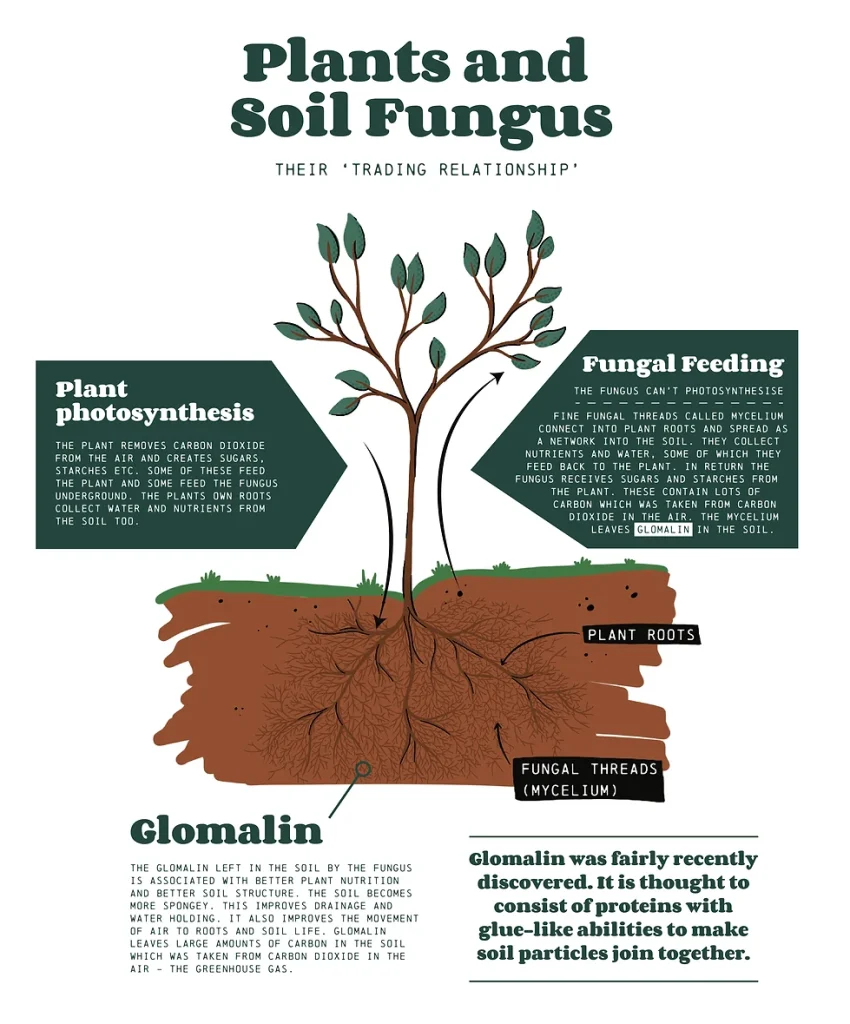
Of the carbon held in the soil one third appears to be held in a recently discovered substance called glomalin. Glomalin is created in the ground when plant roots and soil fungi grow symbiotically.
Almost all of the crops we grow, indeed all the larger plants on earth, rely on their relationship with fungi to thrive. Amongst commonly grown vegetables only the cabbage family grow without using this co-operative relationship. The plants pass down starches and sugars (containing carbon) to the soil fungi and the fungi pass back important nutrients derived from the soil. These nutrients include nitrogen and phosphorus.
How to increase the glomalin in the soil
So how could we increase the amount of glomalin in our soil? Firstly we need to be wary of any unnecessary digging or tilling. When we dig or till the soil we tend to break up the fungal networks it contains. One spadeful of healthy soil can contain miles of fungal threads. Digging and tilling the soil tends to break up these threads. It also exposes carbon in the soil to oxygen in the air which can convert it back to the carbon dioxide which we need to reduce.
A no-dig approach, which involves sowing or planting into soil which has only been slightly disturbed, reduces the danger of loss of glomalin and of soil carbon. The addition of artificial fertilisers, particularly those containing phosphorus, also works against the retention of glomalin.
Other ways to reduce soil disturbance
If we add to these approaches further methods of reducing soil disturbance and capturing nutrients we can save glomalin and soil nutrients.
- We might use green manures.
- We might plant perennial crops which are capable of drawing up nutrients from the soil with minimal soil disturbance.
- We can plant catch crops or cover crops. Catch crops are fast growing crops grown between plantings of a main crop. Examples are lettuces between sweetcorn or radishes between many slower crops. Cover crops are planted to cover bare soil. Depending on the crop they might harvest nutrients from the soil, stop soil eroding, help control weeds, improve soil fertility or preserve biodiversity. Even leaving a few annual weeds on the soil over winter might provide some of these benefits if they are cut down and composted before they are allowed to seed.
The government has declared its intention to improve our soil quality. Regenerative agriculture, also known as agroecology, is becoming widespread in the UK. As growers we can be part of this urgent movement.